
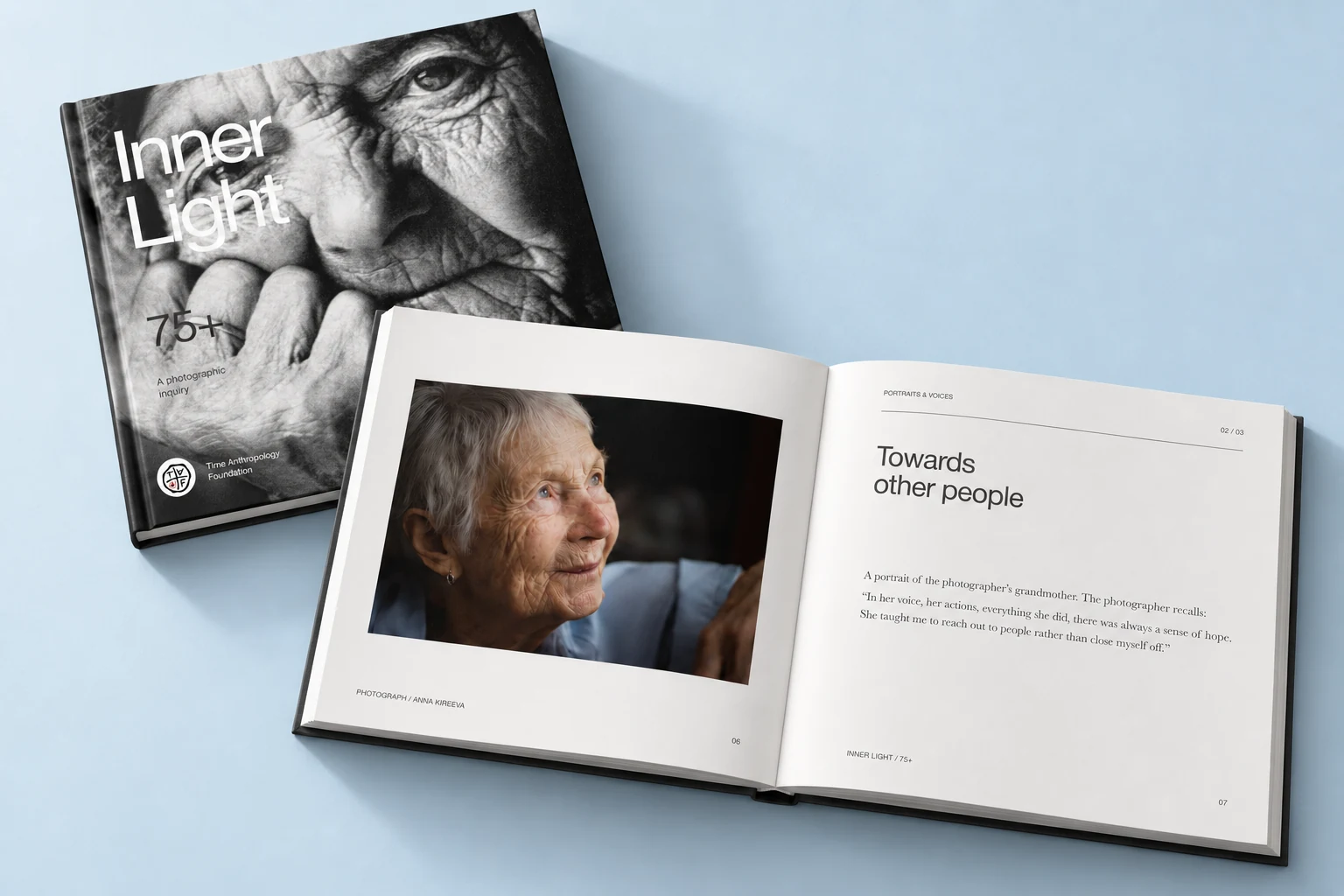
Inner Light
75+How do you photograph light that has no photons?
Photographers were given a brief: show the inner light you see in someone over seventy-five. The portraits they sent became an inquiry into what we recognise in one another — and an art book drawn from 1,600 encounters.
- Portraits submitted
- 1,600
- Participant questionnaires
- ~500
- Essays by photographers
- ~200
01 / An unexpected convergence
What gives life meaning?
What gives you strength to live?
Asked separately, these questions often drew overlapping answers. The research team found a connection between meaning and the strength to go on living.
The essays return to love and connection: family, friendship, care, a community of people close in spirit. The photographs meet the words of the people pictured.
Reading the material
Look through the findings.
What is hardest about old age?
The questionnaires also asked about difficulty. Loss of strength and loneliness account for most of the reported responses.
One person. A shared encounter.
Most portraits show a single person. The book locates inner light between three: the subject, the photographer and the viewer.
How old is the light?
The invitation began at seventy-five. The portraits extend into lives beyond ninety. Ages refer to the original project.
What colour is inner light?
Most submissions were in colour. The choice of photographic treatment became part of the material the researchers examined.
Who appears in the portraits?
Women make up two-thirds of the people represented in the project. These figures describe the submissions, not the general population.
Where does the encounter happen?
In most portraits, the setting could not be identified. Where it could, the project recorded village, town or city, and natural surroundings.
1 / 6
Reported percentages from the original 2020–2021 project. These describe the submitted material; the published charts do not specify the base for each percentage.
02 / The encounter
Another image of growing old.
What might an old age at ease with itself look like? These portraits invite us to reconsider the images of age we carry into our own future.
Select a spread to enlarge.
03 / A method developed through five inquiries
The invitation is also the method.
A photography competition becomes a form of inquiry. The choice of a person, the making of a portrait and the accompanying words all become research material.
Inner Light is the fifth photographic inquiry in a sequence developed by SREDA, now Time Anthropology Foundation. Earlier projects explored the holy and the precious, sacred places, soul and time. Open participation, visual analysis and personal accounts meet in one practice.
Two perspectives from the book.
Alina Bagrina / Afterword
“Contemporary culture offers few images of an old age that is not trying to look young. An old age confident in itself; freely and calmly accepting and respecting what is; gentle and brave; wise and full of wonder; weak and strong at once.”
Maxim Kalinin / At the crossroads of lights
“Their light is not a given. In it, as in a mirror, we may see different things: human, uncreated, symbolic. The answer will be different for everyone. It appears in the encounter itself, at the crossroads of the lights the heart can discern.”
An open hypothesis / An invitation to neuroscience
Can a portrait change how we feel?
Could encounters with joy and ease in later life change a viewer’s mood, sense of connection or expectations of their own ageing?
Research on facial mimicry — the tendency to echo another person’s expression — has found responses in older adults too. Some brain-imaging research links mimicry to regions associated with the mirror neuron system. Its role in our response to these portraits remains a hypothesis to test.
We invite neuroscientists, psychologists and researchers of ageing to help investigate whether these images make a difference, for whom, and for how long.
Help test the hypothesisResearch behind the question
Bailey & Henry, 2009 recorded facial muscle responses in 40 older and 46 younger adults. Both groups mimicked briefly presented happy and angry expressions.
Likowski et al., 2012 combined facial muscle recording and brain imaging in 20 female students. Mimicry correlated with activity in regions associated with the mirror neuron system; this does not establish the mechanism of responses to the Inner Light portraits.
Warren et al., 2006 studied responses to emotional vocal sounds, including laughter. Hearing these sounds engaged regions also involved in facial movement. This was an experiment with sound, rather than still photographs.
These studies motivate the question. They do not establish a health benefit from viewing these portraits or support a claim that doing so prevents neurodegenerative disease.
04 / Curate the next inquiry
Another country.
Another culture.
The same question.
We are looking for a curator and partners to bring Inner Light into another cultural context.
Shape the brief. Invite local photographers. Bring portraits, personal accounts and questionnaires into a new exhibition or publication.
Tell us which place or community you would like to work with, and the role you could take.
Propose a collaborationPhotographs shown: Alexander Stepanenko, Anna Kireeva and Andrey Belozerov. Cover photograph: Alexander Stepanenko. Project figures and texts come from the original inquiry and publication.
Inner Light / 75+
Time Anthropology Foundation